
Focusing on Enhancing English Proficiency, Jointly Exploring Paths for Teaching Improvement ——SCUPI Holds Special Seminar on English Teaching
Published on: January 5, 2026 | Views: 521
To address the challenges in cultivating students’ comprehensive English abilities, deepen the reform of English teaching, and build an English teaching system suitable for the development of engineering talents, the Sichuan University-Pittsburgh Institute (SCUPI) held a teaching seminar titled “Discussion on Enhancing Students’ English Proficiency and Teaching Improvement” on December 25th, 2025.
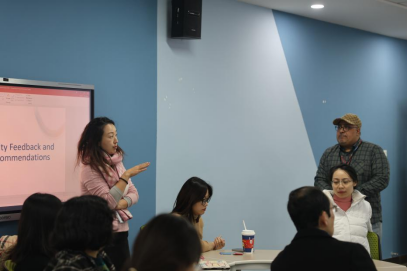
Assistant Dean for Academic Affairs Di Liu and more than twenty faculty and staff members from various majors gathered. Under the chairmanship of Associate Professor Gamil Alamrani, they engaged in in-depth discussions regarding the current state of English teaching, existing problems, and optimization directions, injecting new ideas into improving the quality of English teaching at the Institute.
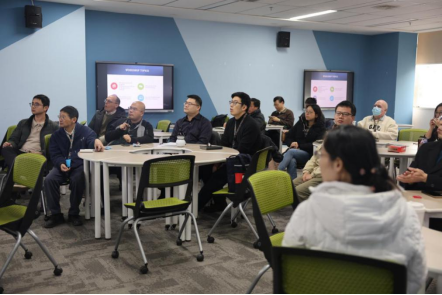
In his opening remarks, Associate Professor Gamil Alamrani emphasized that English, as the lingua franca in the fields of science, technology, and engineering, holds importance throughout the entire process of institutional accreditation, academic research, and professional careers. He then pointed out, citing authoritative data such as recruitment trends of globally renowned companies and ABET accreditation standards, that communication, research, and critical thinking skills should be listed as core training indicators. This led to the presentation of survey data on students’ English proficiency and problem feedback.
During the meeting, Associate Professor Gamil Alamrani provided a detailed analysis of the current state of students’ English abilities and core teaching challenges based on this data. The survey revealed that, in terms of language skills, speaking and reading are the main difficulties for students. Most teachers reported frequent challenges with these two skills, while listening and writing were relatively better. Regarding research skills, students showed weakness in formulating research questions but performed well in using search engines and databases. In the realm of critical thinking, the cultivation of higher-order abilities such as logical thinking and information evaluation still needs strengthening. Furthermore, concerning communication skills, students’ adaptability in different scenarios urgently requires improvement.
He also candidly pointed out that traditional English teaching suffers from issues like a singular course focus and fragmented learning stages, which can no longer meet the needs of students’ holistic development. A breakthrough through teaching optimization is urgently needed. Additionally, the existing English courses focus solely on academic writing, lacking systematic listening and speaking training. Furthermore, there is a discontinuity in the English learning period within the curriculum. Problems such as students’ insufficient intrinsic motivation for English learning and difficulty adapting to diverse accents may become key factors constraining teaching effectiveness.
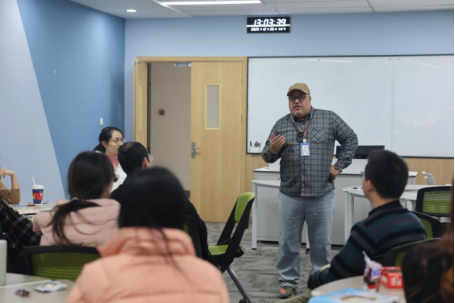
In response to the issues, Associate Professor Gamil Alamrani proposed multi-dimensional, actionable paths for teaching improvement. Regarding the curriculum system, he suggested adding specialized English listening and speaking courses for lower-grade students, tailored to their abilities. For support mechanisms, he advocated for establishing a comprehensive writing center to provide guidance ranging from basic writing to academic research, while also expanding one-on-one consultation services to meet students’ personalized needs in areas like speaking and reading. In terms of teaching models, he championed interdisciplinary collaboration, encouraging teachers of professional courses to incorporate the teaching of discipline-specific English vocabulary and expressions to break down disciplinary barriers. In terms of practice, he proposed enriching forms such as workshops and extracurricular English practice activities to strengthen the application of English in real-world scenarios. He emphasized that various teaching assessments must precisely align with course learning objectives, distinguishing the role of formative assessment in providing process feedback from that of summative assessment in measuring outcomes. Scientific assessment should be used to drive students’ deep engagement in learning.
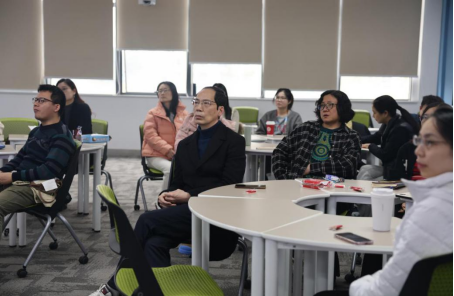
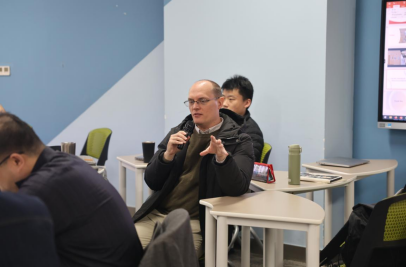
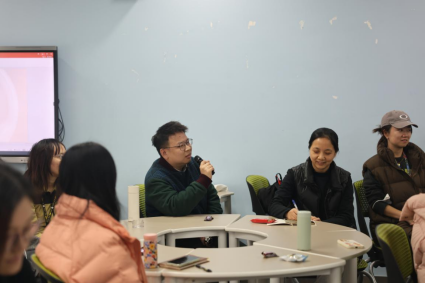
Next, the attending faculty and staff shared their views based on their own teaching experiences. Some teachers, from a linguistic perspective, pointed out that the current English training system at the institute suffers from issues like vague standards, diverse accents, students’ lack of confidence, and inadequate pre-class preparation. Others, from a logical reasoning standpoint, believed that the root cause of students’ weak English logic lies in a deficiency in native language expressive logic, and suggested integrating logic training into daily teaching. Subsequently, teachers shared methods such as secondary quizzes and accumulating professional key vocabulary to enhance students’ discipline-specific English abilities. Furthermore, some teachers recommended reducing the frequency of Chinese usage in the classroom to create an immersive language environment for students. Everyone engaged in lively discussions around topics such as curriculum design, cross-departmental collaboration, and guidelines for AI use, further consolidating consensus on teaching improvement. The seminar concluded in a relaxed and pleasant atmosphere.
This seminar systematically outlined the core issues and directions for improvement in the Institute’s English teaching, providing important references for constructing an integrated English teaching system encompassing “curriculum—practice—support—assessment.” In the future, SCUPI will continue to advance the reform of English teaching, implement various teaching optimization measures, continuously improve teaching quality, assist students in honing their English proficiency and core academic competencies, and lay a solid foundation for cultivating engineering talents with international competitiveness.