
Event Recap丨Intro to Research: An Exploration Guide for Undergraduates—From “What” to “How”
Published on: December 2, 2025 | Views: 579
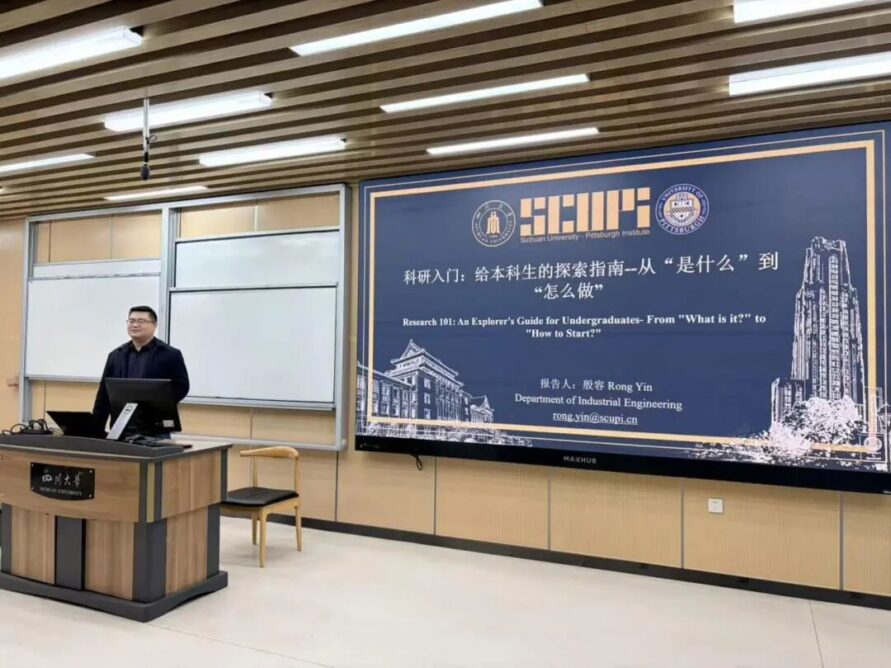
On the afternoon of November 21st, 2025, at Building C of the Comprehensive Building, Jiang’an Campus, all students of the Class of 2027 gathered to attend a research lecture delivered by Assistant Professor Rong Yin from Industrial Engineering at the Sichuan University – Pittsburgh Institute (SCUPI). Titled “Intro to Research: An Exploration Guide for Undergraduates—From ‘What’ to ‘How’,” the lecture provided a systematic, concrete, and inspiring sharing session on the nature of research, practical pathways, and academic writing.
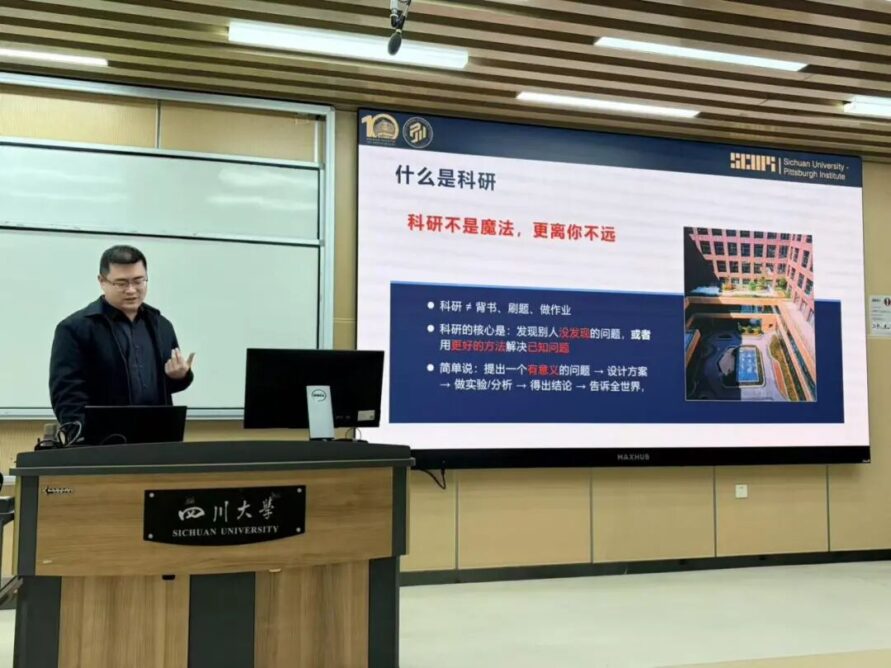
At the beginning of the event, Professor Rong Yin debunked common stereotypes about research in a straightforward and relatable manner. He emphasized that research is not about rote memorization, solving repetitive problems, or completing assigned tasks. Instead, it is a process of “discovering problems others haven’t noticed or solving problems with better methods.” He stressed that undergraduates are fully capable of engaging in research, and it does not require “innate talent as a top student” or expensive laboratory equipment. In fact, many research endeavors start with foundational tasks such as literature reviews, coding, data organization, and visualization—tasks that students are already familiar with and capable of handling.
Next, drawing from his experience mentoring students in research, Professor Yin vividly outlined three stages of growth in research capabilities: starting with reproducing papers and running open-source projects, gradually progressing to modifying parameters and supplementing experiments, and eventually advancing to proposing innovative ideas. He particularly pointed out that the junior and senior years are critical periods for enhancing research abilities. As long as students are willing to start, even the most basic tasks can contribute to the accumulation of research skills, ultimately fostering genuine research capabilities.
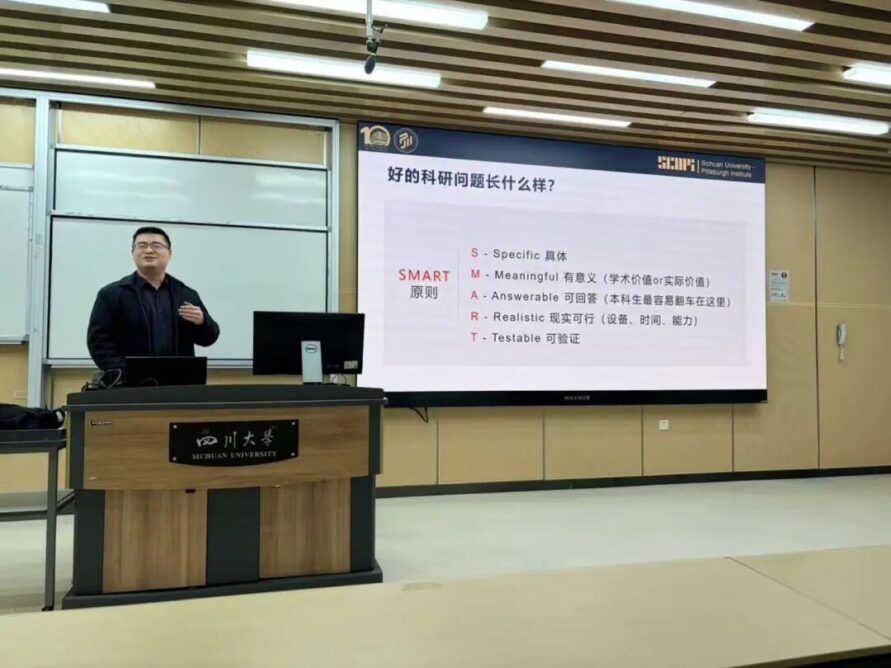
When discussing “how to choose a research topic,” Professor Yin introduced the SMART principles for research topic selection: Specific, Meaningful, Answerable, Realistic, and Testable. He cautioned that the biggest risk for undergraduates is often not “not knowing how to do it,” but choosing topics that are too broad, making them unsupportable in terms of time, resources, or capabilities. He encouraged students to break down problems into smaller, answerable questions and accumulate results step by step.
During the lecture, Professor Yin shared real achievements from students in his research group, including projects on emergency triage optimization, applications of large language models in medical assessments, and the integration of educational resources. These projects yielded outcomes such as software copyrights, patent applications, outstanding conclusions of the University Student Innovation Program, best speaker awards at international conferences, and submissions to SCI-indexed journals. These concrete examples allowed students to see how research connects with real-world problems and how undergraduates can make tangible contributions to practical projects.
When explaining academic writing, he clearly distinguished between different types of papers, such as literature reviews, empirical studies, theoretical research, methodological papers, and case studies. He also detailed the four main components of a typical research paper: Introduction, Methods, Results, and Discussion. Additionally, he introduced the different grading systems for scientific papers domestically and internationally, emphasizing the importance of the research question and the solidity of the study.
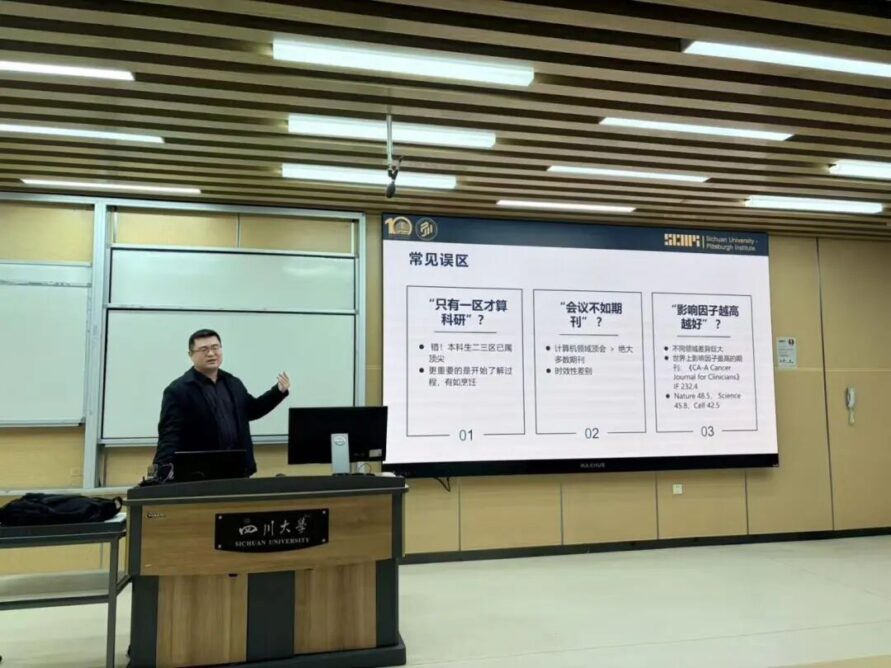
When addressing the question, “What can I actually do?” Professor Yin proposed four actionable pathways for undergraduates to start their research journey: directly contacting professors, participating in research training or the University Student Innovation Program, engaging in overseas summer research, or reaching out to international professors via email. He emphasized that the most important step is to take the first move. There is no need to worry about whether the work is “high-end enough” at the beginning—any hands-on involvement will become valuable experience and a competitive advantage in the future. The professor noted that while research may present short-term challenges, it fosters long-term deep understanding and enhances learning capabilities. The publication cycle for papers may vary, but the key lies in the quality of the research and alignment with the research direction. Moreover, research experience is not only beneficial for further academic pursuits but also highly valuable for employment, particularly in fields such as tech companies, consulting, and supply chain management.
Many students expressed that the lecture transformed research from an abstract concept into a practical pathway, providing them with a clearer direction for future exploration. The event concluded with warm applause, offering essential theoretical and practical guidance for SCUPI juniors embarking on their research journeys.